
A journal, by date
Log an album the day you heard it, with a line about what it was like. Re-listens are marked as re-listens. Read it back as a timeline or as a wall of covers.
Unison is Letterboxd for music — a diary of the records you actually listen to. Log an album, rate it, write down what you thought, and see what the people whose taste you trust have been hearing.
No subscription, no adverts, no paid tier. The Android app is built and its Google Play listing is being prepared.
What it looks like
What Unison does
Unison is not a player and not a recommendation engine wearing a friendly face. It is the place you write down what you listened to and what you made of it — and the place you find out what other people made of it too.
Log an album the day you heard it, with a line about what it was like. Re-listens are marked as re-listens. Read it back as a timeline or as a wall of covers.
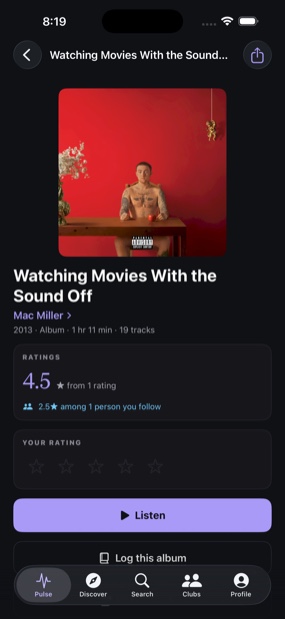
Half stars on an album, and on every individual track if you want to argue about sequencing. Your scores build a picture nobody else's algorithm gets to write.
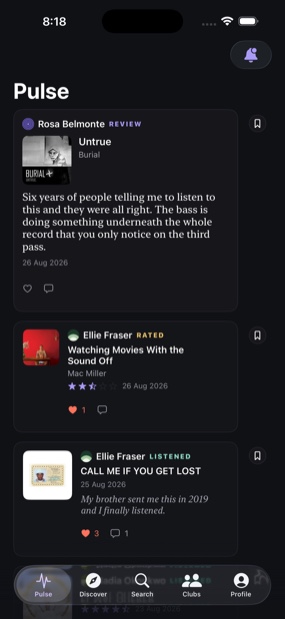
Write properly about a record, decide who can read it, and edit or delete it later. First-listen reviews are marked, because a first impression is a different thing.
Pulse shows what the people you follow have been listening to — not what a label paid to put there. Like a listen, reply to it, or take the record for yourself.
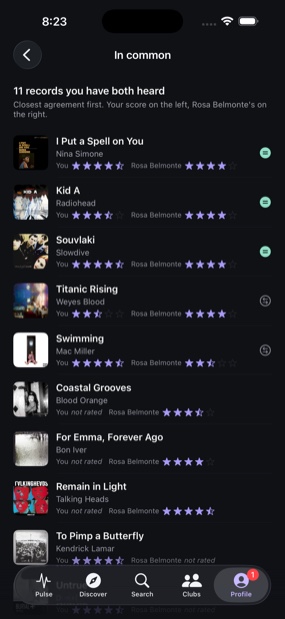
Publish a ranked list with a note under each record saying why it is there. Make one collaborative and it offers the records you and the others already have in common.
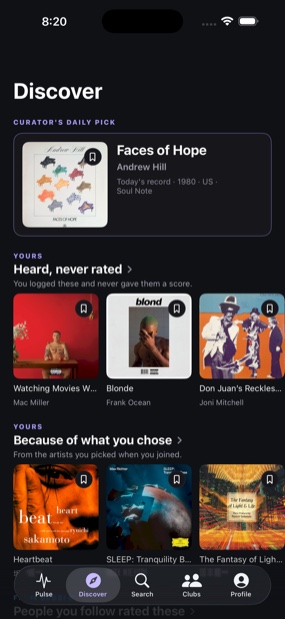
Named queues for the records you mean to get to. Log one and it leaves the queue on its own — and tells you what it removed, so nothing disappears quietly.
A few people, one record at a time. Everyone puts an album forward and says why, then the club votes and listens to whatever wins.
Send a record to someone and talk about it. Only with people you both follow, so an inbox stays a conversation rather than a place strangers arrive.
Search an artist Unison has not heard of and it goes and fetches their discography — covers, tracklists and all. If the results still miss, one button asks for the rest.
Yours, and only as public as you say
Who can see the records you log and who can see what you wrote about them are two separate settings, because they are two separate questions. A public log with private notes is a perfectly normal thing to want, and it works.
Set each independently. The rule lives in the database, not in the app, so nothing can show somebody a record you told it to hide.
Every record has a Listen button that opens Spotify, Apple Music, Tidal, Qobuz, Amazon Music or YouTube Music — whichever you already pay for. Unison does not want to be your player, and it does not want your listening history from anyone but you.
If you already know the shape
People ask for both by name, and both are fair. Here is what the comparison actually buys you, and where music needed something different.
| What you already do there | What Unison does with it |
|---|---|
| Log a film the night you watch it | Log an album the day you hear it, with a note, a rating, and a mark when it is a re-listen rather than a first time. |
| Keep a watchlist | Want to Listen — several named queues, not one pile. Logging a record clears it out of them for you. |
| Rate out of five | Half stars on the album, and on every track. A record with two perfect songs and eight fillers should not have to average into a shrug. |
| Write a review | A line or an essay, and you choose who reads it. First-listen reviews are labelled as such. |
| Publish a ranked list | Lists with an argument under each entry — and collaborative ones, where the app offers what you and the others already have in common. |
| Follow people and read their diaries | Pulse: a feed of listens and reviews you can like and reply to, plus Clubs, where a few people pick one record together and argue about it properly. |
Questions
That is the closest comparison, and it is the one most people arrive with. Letterboxd is a diary of the films you watch; Unison is a diary of the records you listen to. You log an album with the date you heard it, rate it, write a line or a full review, and it goes into a journal you can look back over. The people you follow appear in a feed, and you can like and reply to what they have been hearing.
In the same way, yes. Goodreads keeps a shelf of what you have read and what you mean to read next. Unison keeps a journal of what you have heard and a Want to Listen queue of what you mean to hear, along with lists you can publish or build together with other people.
No, and it never will. Unison is where you write about music, not where you play it. Every record has a Listen button that opens it in whichever service you already pay for — Spotify, Apple Music, Tidal, Qobuz, Amazon Music or YouTube Music. You pick the default once and it stays.
Nothing. There is no subscription, no advertising, and no paid tier waiting behind the free one.
Search for it and Unison goes and fetches it. If the catalogue does not already hold an artist, searching brings in their discography — covers, tracklists and all — usually in a few seconds. And because a near miss is commoner than a total miss, there is a button under every set of results that asks for whatever the results did not have.
No. Unison asks what you like when you sign up, and you can skip the whole thing and let it learn from what you log instead. You can come back and fill it in later from Settings.
It is coming. The Android app is built, and its Google Play listing is being prepared — the badge above goes to it, and answers a "not found" until the day it is published. It is the same account and the same journal as the iPhone app: nothing to export, nothing to migrate, and the records you log on one phone are on the other.
The albums you have heard this year are worth more than a scrobble count. Write them down.

iPhone and iPad · iOS 17 or later. Android is coming to Google Play.